

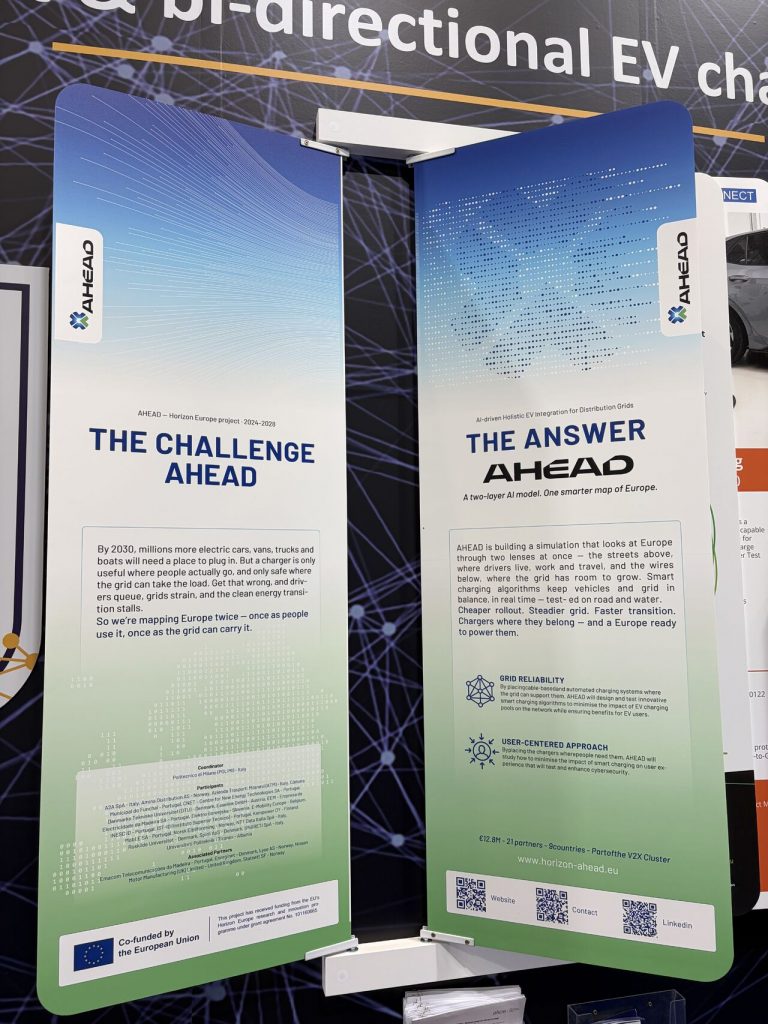
The AHEAD project travelled to Budapest, Hungary, from 18 to 21 May to take part in this year’s Transport Research Arena (TRA), one of Europe’s largest events dedicated to transport research and innovation. The conference provided an excellent platform to present the project’s progress and achievements to a wide audience of experts, stakeholders, and policymakers.
AHEAD was represented by Gabriele Pesce and Evan Bernardi from E-Mobility Europe, who introduced the project on several occasions and engaged with visitors at the project corner. Their presence helped raise awareness of AHEAD’s innovative approach to the deployment of charging stations and its contribution to the wider electrification of transport.
Together with partners from the V2X Cluster, AHEAD was also featured at the ALICE (Alliance for Logistics Innovation through Collaboration in Europe) booth. There, Evan Bernardi delivered a pitch presentation highlighting the project’s objectives, methodology, and the progress achieved across the demo sites, further strengthening the project’s outreach and visibility.
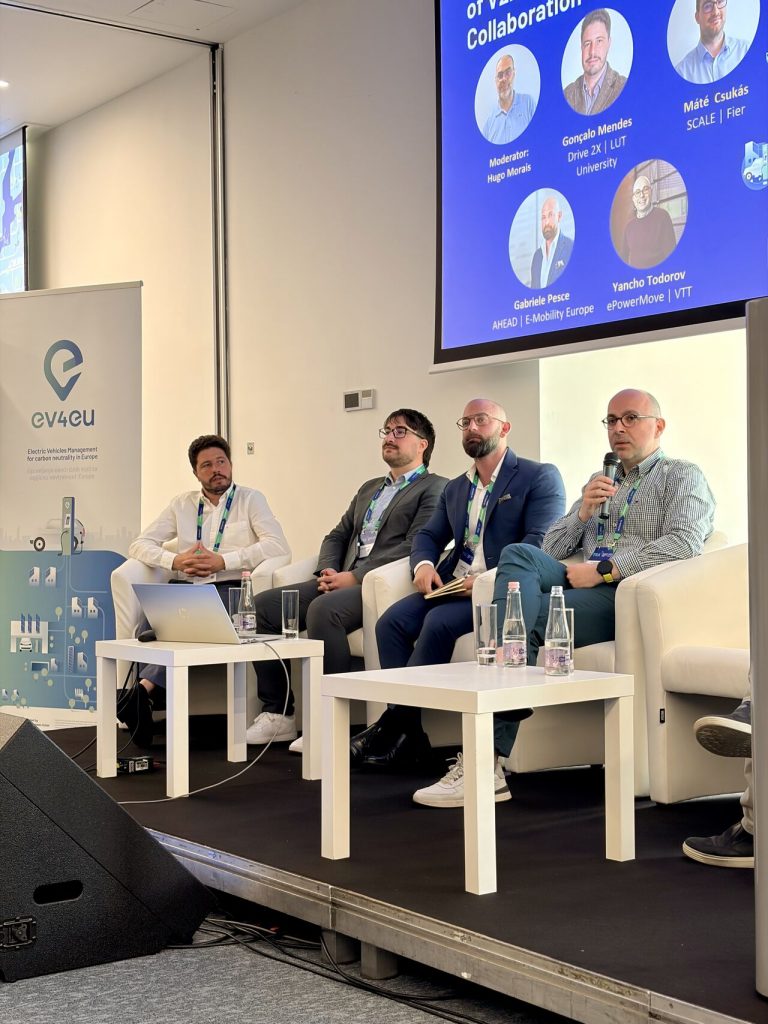
Gabriele Pesce took part in the EV4EU final event held within the TRA 2026 programme. In his intervention, he spoke about AHEAD and the value of clustering with like-minded projects. He stressed the importance of exchanging ideas and best practices, as well as the role that collaborative initiatives can play in building momentum for greater awareness, stronger investment, and the policy support needed to accelerate the rollout of V2X technologies.
After four days in Budapest, the AHEAD partners returned with a clear message: electromobility is a key part of Europe’s transition toward a more efficient and decarbonised transport sector. Just as importantly, projects like AHEAD are helping to develop the technologies and cooperation models needed to speed up the uptake of electric mobility, from passenger cars to vessels.
A 2-layer approach for the deployment of charging stations
One of the main challenges facing the rollout of electric vehicles in Europe is the lack of a dense charging infrastructure. While petrol stations are widely available for combustion cars, trucks, buses, and boats, the same cannot yet be said for electric mobility. Building a reliable charging network also requires careful consideration of two essential factors: demand for charging points and the resilience of the electricity grid.
This is precisely the challenge AHEAD is working to address. By using artificial intelligence (AI) and other advanced technologies, the project is developing a two-layer tool that can identify where demand for charging is highest and where the grid can supply the necessary energy without requiring major upgrades or creating price imbalances. The tool is being tested in demo sites across Europe — in Portugal, Italy, Denmark, and Slovenia — each with different local conditions, usage patterns, and vehicle types. This broad testing environment will help ensure that the solution is robust, adaptable, and capable of responding to the needs of EVs, heavy-duty vehicles, and vessel fleets.
AHEAD is also paying close attention to cybersecurity. Project partners are studying how cyberattacks could disrupt the system and are developing prevention and response mechanisms designed to reduce potential damage and improve resilience.
Equally important is the project’s work on V2X solutions, which allow vehicles not only to draw energy from the grid but also to feed electricity back into it. This bidirectional approach could help support the system during periods of high demand, ease pressure on energy prices, and contribute to a more circular transport sector in Europe.