
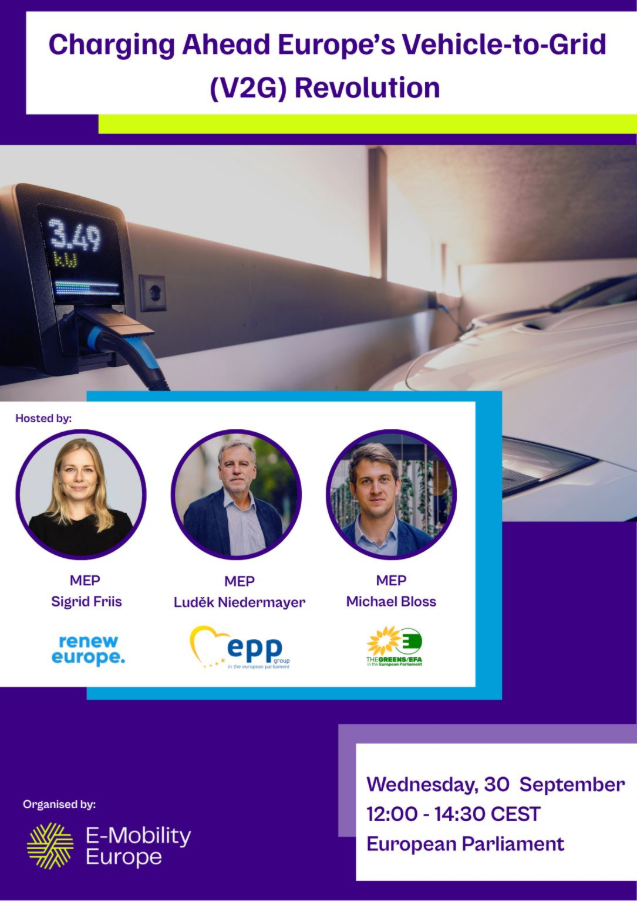
Organised by E-Mobility Europe, the event Charging ahead Europe’s Vehicle-to-Grid (V2G) Revolution, was held in the European Parliament, in Brussels, on 30 September. The event brought together private initiate stakeholders and policymakers, including MEPs Sigrid Friis (Renew-DK), Luděk Niedermayer (EPP-CZ), and Michael Bloss (Greens/EFA-DE), showcasing the relevance of the topics in the EU’s agenda.
Vehicle-to-grid (V2G) technology has significant potential to support electricity grids by providing flexibility services. As electric vehicles (EVs) become increasingly widespread, their role in the energy system is also gaining importance. EV batteries can store substantial amounts of electricity and, when aggregated, feed energy back into the grid, helping balance supply and demand and ease pressure during peak consumption periods.
Projects such as AHEAD are exploring this relationship between electric mobility and the energy system, testing how bidirectional charging can support grid flexibility under real-life conditions. The technology is increasingly mature, and its potential benefits are clear. However, technological readiness alone is not enough to ensure widespread adoption. Regulatory barriers, particularly the lack of harmonised rules across European energy markets, remain a major obstacle to V2G deployment.
Addressing these challenges was precisely the objective of E-Mobility Europe’s event in Brussels. The event aimed to bring policymakers and industry representatives together to discuss how effective policy and regulatory frameworks can unlock V2G’s full potential across Europe.
Lisa Calearo, from AHEAD partner Spirii, attended the event and highlighted the complexity of aligning electric mobility with Europe’s diverse energy systems. According to her “V2G is directly tied to the energy sector, and grids, tariffs and market rules still vary a lot across EU countries. Harmonising a protocol is one thing. Harmonising how cars interact with 27 energy systems is another.”
Despite these challenges, there are signs of progress ahead. The European Commission is working on key policy initiatives to facilitate the integration of the transport and energy sectors. Among them, the Electrification Action Plan and the European Grids Package aim to address existing barriers, simplify procedures and improve the conditions for electrification across the EU.
As Europe moves towards a more integrated and flexible energy system, ensuring that regulatory frameworks keep pace with technological developments will be essential. V2G is no longer just a future possibility: the next challenge is creating the right conditions for it to become a widespread reality. AHEAD and other like-minded projects are helping in this mission. By testing different scenarios, including grid limitations, fast and slow charging, and public and private charging locations, the projects can help analyse how EVs and the grid interact and how EVs can become an asset for the electric sector rather than a burden.